collection
ACCESSORIES
Journal
about


View account

Sign out



Worldtime watches traditionally offer a familiar tour of the globe. London. New York. Tokyo. The usual suspects, and for good reason.
The more interesting decisions begin in the spaces between them. Which location represents UTC−2? What about UTC−8 without daylight saving time? And should a three-letter code refer to an airport, a city, or simply whatever fits around the dial?
Naturally, we have opinions.
The locations used on certain MING worldtime watches reflect a personal selection by Ming Thein (MT). Some abbreviations are standard IATA airport codes. Others, including NYC and CHI, are IATA metropolitan-area codes covering cities served by several airports. And then there are codes such as TOK (Tokyo), which simply refer to the city itself. You generally travel to visit a city, after all, not its airport. Or at least that's the goal.
A few codes are less familiar and may send you directly to Google Maps. Several locations also reflect MT's individual connection to them. The result covers the obvious destinations alongside places you probably weren't expecting.
The MING 29.01 family took a more literal approach, mostly spelling out the complete names of its featured cities and locations. Our first worldtime watch, however, was the 19.02 Worldtimer. Introduced in 2019, it used three-letter abbreviations throughout and has prompted questions ever since: “What is SWI?” “Why does Phoenix say PHE?” and “Where exactly is Apia?”
The new MING 57.05 Comet, released in August 2026, goes even further.
Its patent-pending DST-adjustment system separates locations into two groups. Those unaffected by DST remain fixed on the inner bezel, while those that observe it sit on the outer bezel, which can be advanced one hour with a single 15-degree click.
This means the Comet needs more reference locations than a conventional worldtimer. Finding a recognizable place at every UTC offset is easy until you need one that follows, or resolutely refuses to follow, daylight saving time.
That is exactly how Adamstown, with a population roughly equal to the guest list for a small RedBar gathering, earns equal billing with San Francisco in standard time and Anchorage when the DST bezel advances.
Here is the complete decoder.

The 19.02 uses one reference location for each of the 24 full-hour offsets.
API: Apia, Samoa — UTC+13
WLG: Wellington, New Zealand — UTC+12
NOU: Nouméa, New Caledonia — UTC+11
MEL: Melbourne, Australia — UTC+10
TOK: Tokyo, Japan — UTC+9
KUL: Kuala Lumpur, Malaysia — UTC+8
BKK: Bangkok, Thailand — UTC+7
DHK: Dhaka, Bangladesh — UTC+6
KAR: Karachi, Pakistan — UTC+5
DXB: Dubai, United Arab Emirates — UTC+4
IST: Istanbul, Türkiye — UTC+3
CPT: Cape Town, South Africa — UTC+2
ZRH: Zürich, Switzerland — UTC+1
GMT: Greenwich Mean Time — UTC±0
AZO: Azores, Portugal — UTC−1
SWI: South Sandwich Islands — UTC−2
BAI: Buenos Aires, Argentina — UTC−3
CAR: Caracas, Venezuela — UTC−4
NYC: New York City, United States — UTC−5
CHI: Chicago, United States — UTC−6
PHE: Phoenix, United States — UTC−7
SFO: San Francisco, United States — UTC−8
ANC: Anchorage, United States — UTC−9
HNL: Honolulu, United States — UTC−10
Yes, PHE means Phoenix. The 57.05 uses the more familiar PHX. Even our abbreviations occasionally receive a model update.
You can read more about the MING 19.02 Worldtimer here.
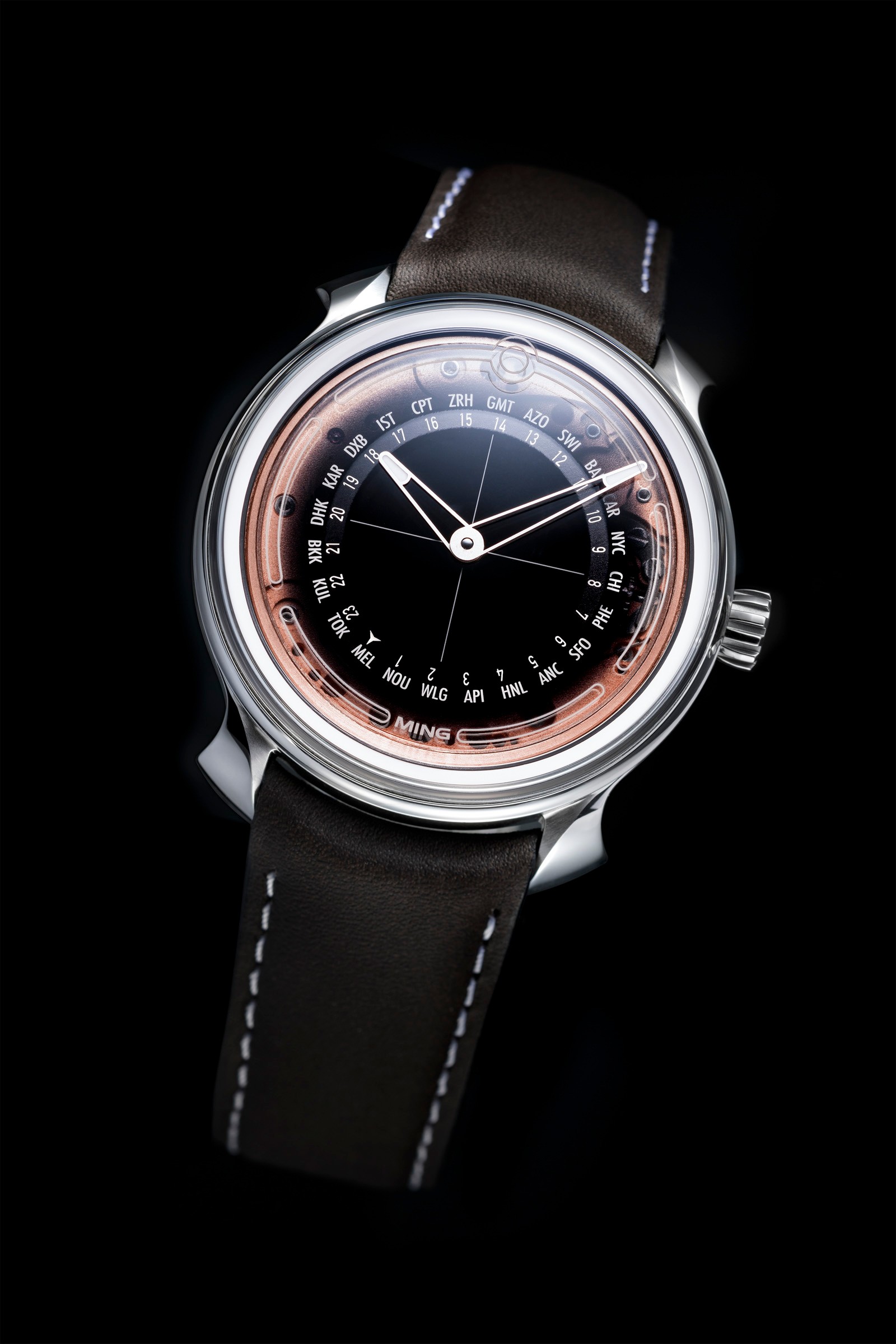
These locations remain fixed when the Comet's outer DST bezel advances. The listed offsets correspond to their normal standard time.
GMT: Greenwich Mean Time — UTC±0
FEZ: Fez, Morocco — UTC+1
CPT: Cape Town, South Africa — UTC+2
RUH: Riyadh, Saudi Arabia — UTC+3
DXB: Dubai, United Arab Emirates — UTC+4
KAR: Karachi, Pakistan — UTC+5
DHK: Dhaka, Bangladesh — UTC+6
BKK: Bangkok, Thailand — UTC+7
KUL: Kuala Lumpur, Malaysia — UTC+8
TOK: Tokyo, Japan — UTC+9
BNE: Brisbane, Australia — UTC+10
NOU: Nouméa, New Caledonia — UTC+11
SUV: Suva, Fiji — UTC+12
PPG: Pago Pago, American Samoa — UTC−11
HNL: Honolulu, United States — UTC−10
ADM: Adamstown, Pitcairn Islands — UTC−8
PHX: Phoenix, United States — UTC−7
MEX: Mexico City, Mexico — UTC−6
DOM: Santo Domingo, Ecuador — UTC−5
CAR: Caracas, Venezuela — UTC−4
BAI: Buenos Aires, Argentina — UTC−3
SGO: South Georgia — UTC−2
CPV: Cape Verde — UTC−1
The blank divisions indicate offsets where we did not include a suitable location that remains on standard time year-round.
If you're curious, yes, ADM is the famous Adamstown, the only settlement in the Pitcairn Islands. It does not observe daylight saving time, making it unusually useful for the Comet, even if it has yet to become a major stop on the global watch-event circuit.

These locations observe daylight saving time. Their standard offsets appear first, followed by their DST offsets after the bezel advances one click.
LON: London, United Kingdom — UTC±0 standard / UTC+1 DST
EUR: Central Europe — UTC+1 standard / UTC+2 DST
ATH: Athens, Greece — UTC+2 standard / UTC+3 DST
MEL: Melbourne, Australia — UTC+10 standard / UTC+11 DST
NOR: Norfolk Island, Australia — UTC+11 standard / UTC+12 DST
NZL: New Zealand — UTC+12 standard / UTC+13 DST
ANC: Anchorage, United States — UTC−9 standard / UTC−8 DST
SFO: San Francisco, United States — UTC−8 standard / UTC−7 DST
DEN: Denver, United States — UTC−7 standard / UTC−6 DST
CHI: Chicago, United States — UTC−6 standard / UTC−5 DST
NYC: New York City, United States — UTC−5 standard / UTC−4 DST
HAM: Hamilton, Bermuda — UTC−4 standard / UTC−3 DST
AZO: Azores, Portugal — UTC−1 standard / UTC±0 DST
Oh, and not every label refers to a city. EUR, NZL, AZO, CPV, NOR, and SGO represent regions, countries, islands, or territories. GMT, of course, is an internationally recognized time standard.
And that, in the end, is part of the fun. A worldtime watch should do more than tell you the hour somewhere else. It should make you wonder where that somewhere is.
You can read more about the MING 57.05 Comet here.