collection
ACCESSORIES
Journal
about


View account

Sign out


The easiest way to understand the MING Polymesh is by holding it.
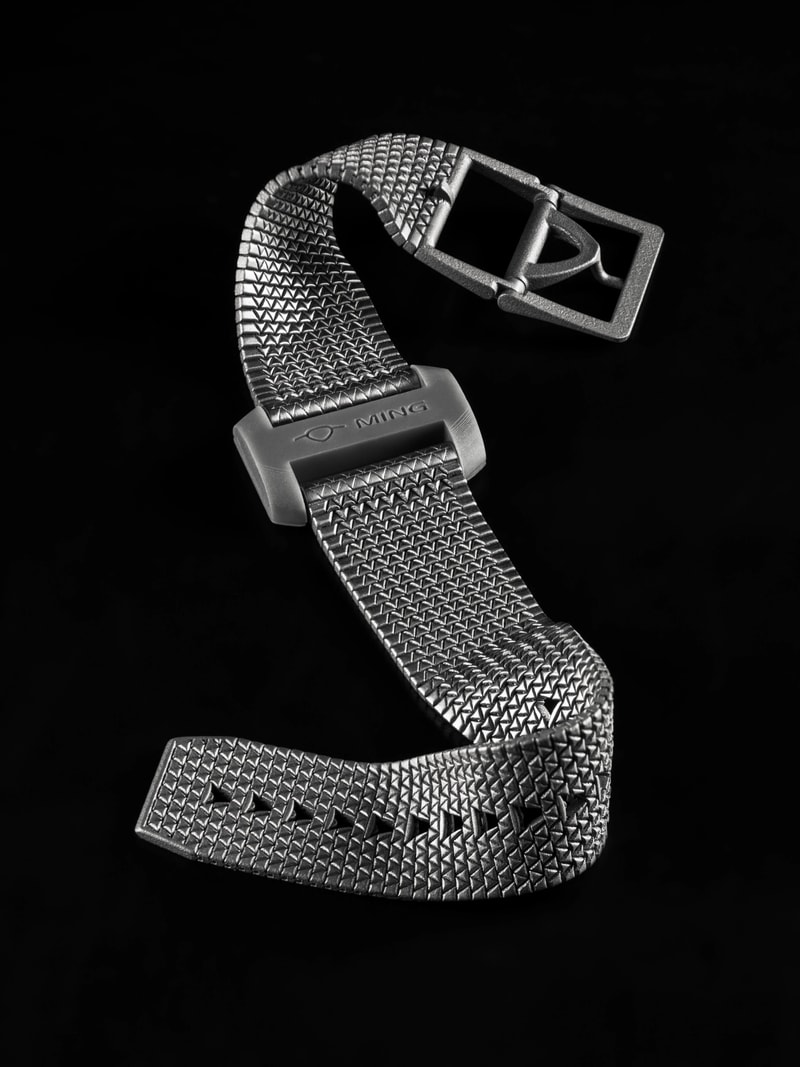
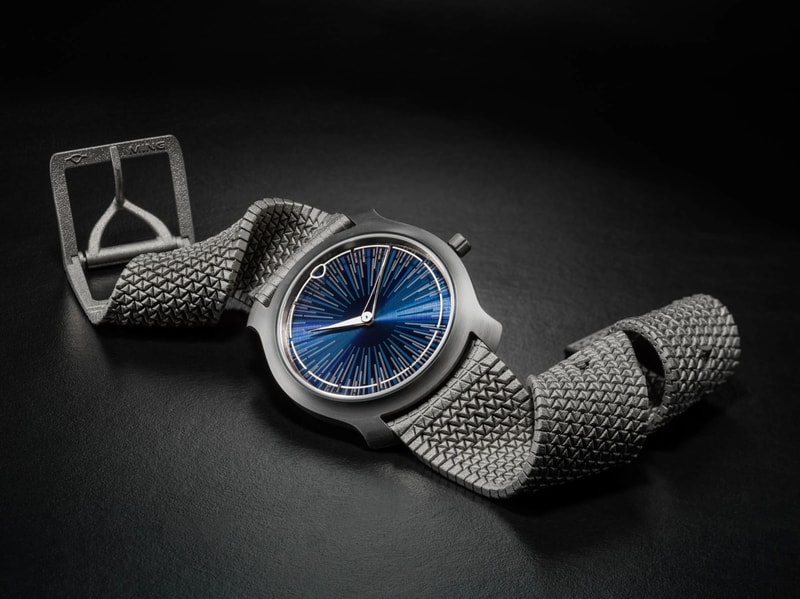
At first glance, the Polymesh may resemble a conventional mesh bracelet, but as soon as you pick it up or strap it on, it becomes clear that it behaves very differently. The structure flexes and flows with the softness of fabric, despite being made entirely from grade-5 titanium.
That's because the Polymesh is something new – a design that straddles the boundaries of familiar categories like bracelets and straps. In combining the strength and tactility of metal with the comfort of cloth, it represents something unique: the world's first 3D-printed titanium bracelet-strap hybrid.
With the introduction of the Polymesh – Straight in April 2026, the concept expands even further. Now, the Polymesh can be adapted to watches beyond the MING catalogue for the first time.
But the real story behind the Polymesh is not solely about comfort or compatibility. It is about how advances in manufacturing technology can enable entirely new forms of design.

Traditional watch bracelets are assembled from individual links connected by pins or screws. Even the most refined examples follow this basic principle: separate components produced individually, then assembled.
The Polymesh takes a radically different approach. Instead of machining each link individually, the entire bracelet is printed in a continuous, articulated format. Each Polymesh contains around 1,700 interconnected elements (to be precise, 1,693 in the curved design; 1,742 in the straight version), all created simultaneously during the manufacturing process.
These tiny elements hook into one another in a continuous closed-loop topology. There are no screws, no pins, and no assembly at all. Even our signature integrated tuck buckle and its articulated tang hinge are formed at the same time and are not separate items.
The only components added later are the quick-release 20mm spring bars.
Developing the Polymesh initially took roughly one year. During that time, it underwent seven complete redesigns and optimizations before arriving at its final form. Throughout this process, Ming Thein (MT) used 5:1 scale plastic prototypes produced by 3D printing to study and refine how the structure moved and articulated, allowing the flow characteristics of each iteration to be evaluated.
A key objective in the Polymesh’s development was understanding how the entire structure would move. Unlike a conventional metal bracelet, the Polymesh has more motion engineered into its radial axis than its lateral one, allowing it to wrap naturally around the wrist while still supporting the watch head securely. One advantage of this approach was that the degree of movement could be tuned locally: by precisely controlling the clearances between individual elements, the articulation of different sections of the bracelet was considered and defined during the design stage.
Such a design would have been impossible to implement using traditional machining techniques. Instead, it was produced using a process called Direct Metal Laster Sintering (DMLS), which falls under the broader category of additive manufacturing. Essentially, this technique involves the fusion of successive layers of ultra-fine titanium powder with lasers until the bracelet gradually takes shape.